
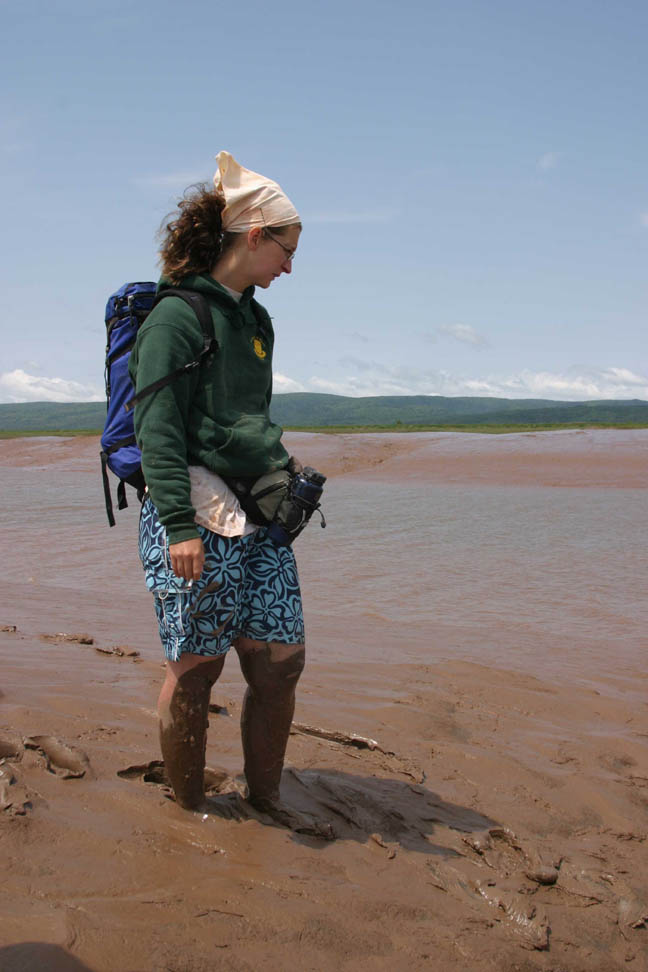
I graduated with a B. Sc. in Geology from the University of Alberta in June 2002. I started my Master’s with Dr. George Pemberton in September 2002 and in September 2003 added Dr. Murray Gingras as a co-supervisor.
I am researching the sedimentology and ichnology of modern main channel point-bar and tidal flat deposits in the Bay of Fundy. I focus on the deposits housed in the inner portion of the estuary, more precisely the deposits found in the NE portion of Chignecto Bay. This system is mud-dominated and most sections have less than 10% sand within them. Within these environments an ichnological gradation from the lower- to the upper-intertidal zones was observed. At the Shepody River locale the gradation is from polychaete (Heteromastus––lower intertidal) to amphipod (Corophium volutator––middle intertidal) to bivalve (Macoma balthica––upper intertidal) dominant. The resulting trace forms are Skolthios and Polykladichnus in the lower intertidal, Arenicolites and Diplocraterion in the middle intertidal, and Siphonichnus in the upper intertidal. At Mary’s Point the lower intertidal is dominated by polychaetes (Heteromastus, Nereis virens, Cerebratulus lacteus and Glyceriid polychaetes), the middle intertidal by amphipods and some polychaetes (Corophium volutator, Heteromastus, Nereis virens and diversicolor), and the upper-intertidal by bivalves and amphipods (Macoma balthica and Corophium volutator). The coinciding trace gradation is from Skolithos, Polykladichnus, Palaeophycus and Planolites in the lower intertidal to Arenicolites, Diplocraterion and Polykladichnus in the middle intertidal to Siphonichnus, Arenicolites and Diplocraterion in the upper intertidal. At Mary’s Point a variety of vertebrate traces are also found. These traces are Undichnia (fin traces), Piscichnus (foraging and feeding pits of fish), and bird trackways.